Landmark · Mellah
Synagogue Slat Lkahal
Slat Lkahal, the community synagogue, has stood over a vaulted passage since the 1850s, at number 119 on the mellah’s main street, 3 minutes’ walk from Bab Doukkala. The association that has been restoring it since 2011 publishes no hours and no prices, so write to it before you go.
updated on
A synagogue built over the street
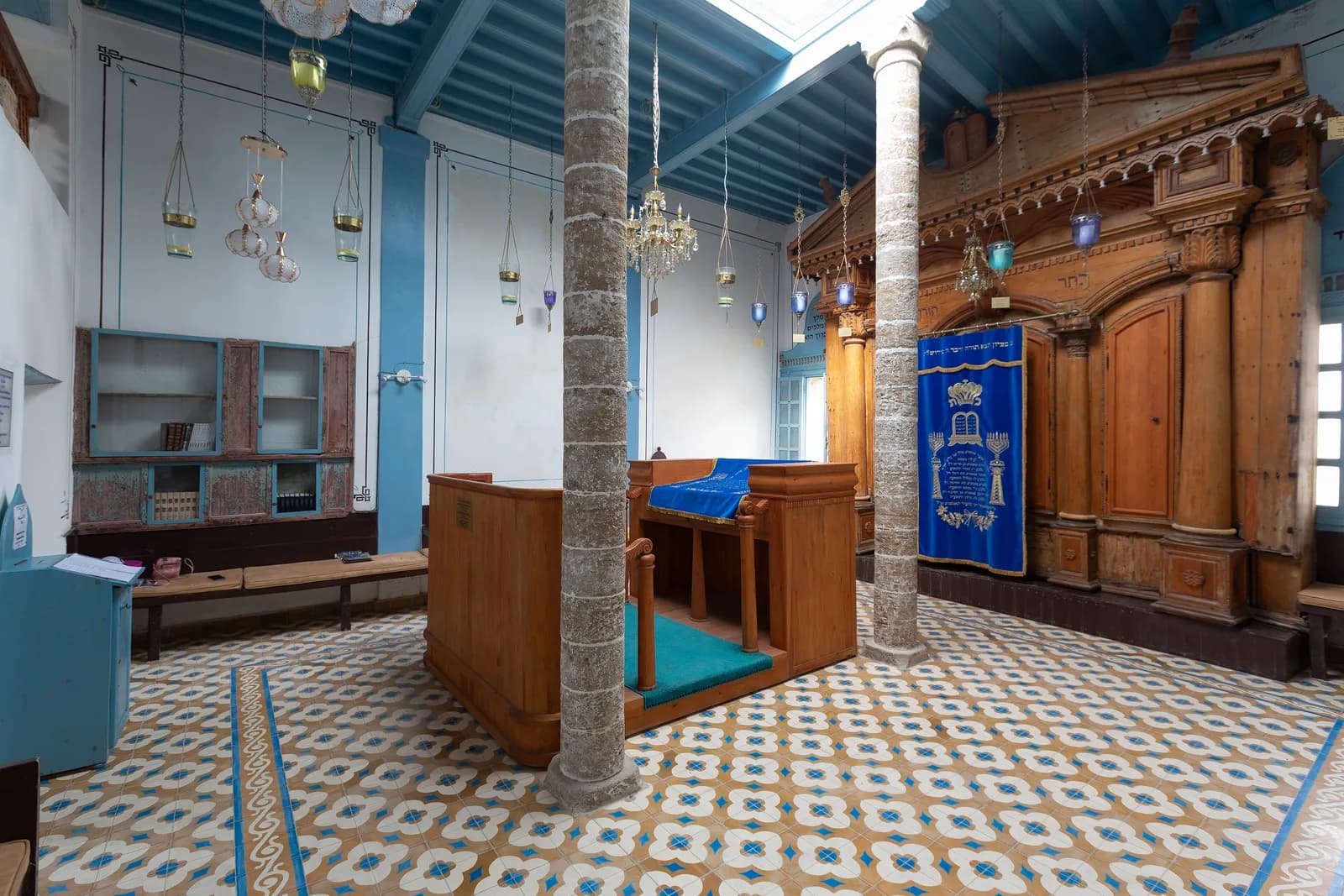
Slat Lkahal means “the community’s synagogue”. According to the association that is restoring it, the foundation stones went down in 1850, paid for with money collected at funerals, and the hall opened in the 1850s. The mellah had no free plot left. So the builders vaulted over the main street at the entrance to the quarter and raised the synagogue on top of the passage. It has a ground floor and two storeys, 117 m² of floor space, and a prayer hall of about 60 m² laid out for some 200 worshippers.
The hall closed in the early 1970s. In 2016 the association wrote that light had returned after 44 years of darkness. When it first came in, in January 2008, squatters were living there and the place had been looted: the teba, the reading table, and the hanging lanterns were gone. Its website documents four phases of work between 2011 and 2016. The prayer hall roof came first, to make the building watertight, then the north façade, finished in March 2013. The project won UNESCO support in May 2012.
The 2016 phase is the one that matters to a visitor. The stolen teba was rebuilt then, to a design of Tuscan origin and made in Essaouira. The stolen decorations of the hekhal, the Torah ark, were remade, and the women’s gallery was rebuilt. Our view: look at the teba and the hekhal first, the two pieces remade after the looting. The project also planned exhibition rooms in the old side rooms, and the website does not say whether they are open. We have not yet timed a visit.
Hours and admission: what the association publishes
As of 17 October 2026, the association publishes no hours, no prices and no visiting terms. Hours do circulate on travel sites, but none come from the association, and we do not repeat them. Its website gives no phone number, so the only direct route is the contact form on asl-mogador.com. Write before you cross the medina, especially if you are coming specially.
Our view: come on a weekday, in the middle of the day, and not on Saturday, which is Shabbat. No official source says whether the door opens that day.
Finding it, and what to see next in the mellah
The door is at number 119 on the main street of the mellah, Essaouira’s old Jewish quarter. Its name depends on the source: rue Moïse to the association, rue du Mellah or “119 Qaraouyine” on maps. From the Bab Doukkala gate, it is 220 m and 3 minutes on foot, on our route calculation. It stands at the start of a covered street: the hall is right above your head.
The Haïm Pinto synagogue is 60 m away, and Bayt Dakira, the House of Memory is 440 m and 6 minutes on foot. Slat Lkahal is a restored synagogue, while Bayt Dakira tells the community’s story. Our view: start at Slat Lkahal, call at Haïm Pinto, and finish at Bayt Dakira. To fit them into a walk round the ramparts and gates, see our pick of Essaouira’s landmarks.
See on the map
The map loads tiles from OpenFreeMap. · Open in Google Maps
Frequently asked questions
Can you visit Slat Lkahal synagogue?
The Slat Lkahal Mogador association, which has been restoring it since 2011, publishes no visiting terms and no hours as of 17 October 2026. Write to it through the contact form on its website before you go.
Is there an entry fee for Slat Lkahal synagogue?
The association that runs it publishes no prices. We will give one only once it does.
What are Slat Lkahal’s opening hours?
No official hours are published as of 17 October 2026. The hours found on travel sites do not come from the association, so ask it through its contact form.
Is Slat Lkahal open on Saturdays?
No official source says, and Saturday is Shabbat. Come between Monday and Thursday, during the day, after writing to the association.
When was Slat Lkahal synagogue built?
The foundation stones were laid in 1850, with money collected at funerals, and the hall opened in the 1850s, according to the association. It closed in the early 1970s, restoration began in 2011, and the latest documented work dates from 2016.
What is the difference between Slat Lkahal and Bayt Dakira?
Slat Lkahal is a restored synagogue with its prayer hall. Bayt Dakira, in the former Slat Attia synagogue, is a house of memory devoted to the town’s Jewish history.