Landmark · Essaouira bay (beach)
Île de Mogador
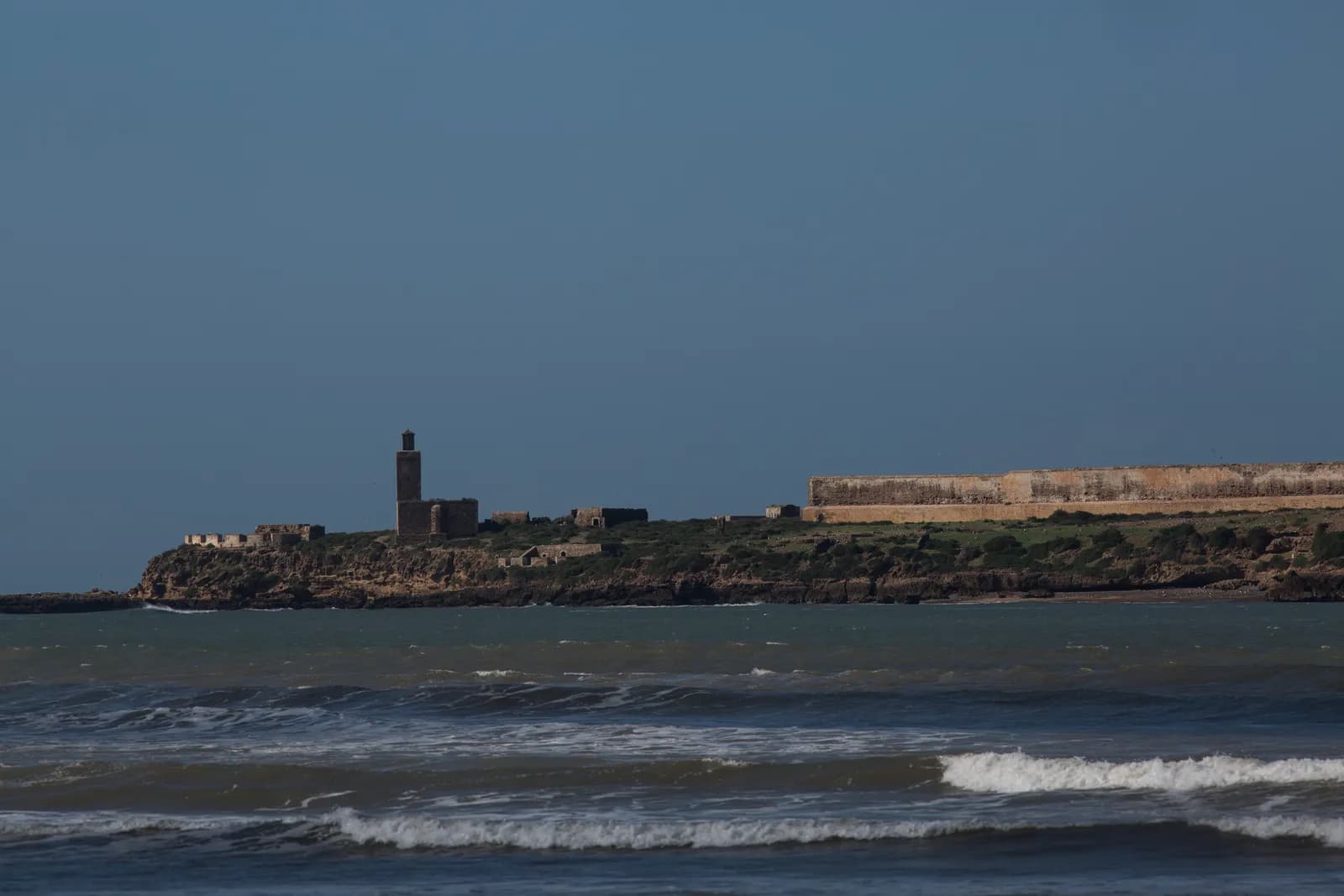
Mogador Island is closed to visitors. A permanent biological reserve since 1980, it bars all landings except by a few registered fishermen. You watch it from the Skala du Port, 1.9 km away as the crow flies, or from the beach. Around 1,500 pairs of Eleonora’s falcons breed there each summer (GREPOM, 2018–2021).
updated on
Why nobody lands on the island
The Mogador archipelago has been a permanent biological reserve since 1980. The island is guarded and nobody lands, bar a handful of fishermen registered with the authorities (GREPOM and Initiative PIM, March 2020). As of 16 October 2026 we have found no public text from the forestry service on how a permit is granted.
That closure is why Eleonora’s falcons came back: about 60 pairs in 1980, then around 1,500 from 2018 to 2021 (GREPOM). Counts in between give 180 pairs in 1999 (BirdLife) and 675 in 2001 (Ramsar sheet). MaghrebOrnitho recorded 940 in 2015, then 1,217 nests in 2016. In 1999 BirdLife still reported yearly landings without a permit. Our advice: turn down any boatman who offers to drop you on the island.
Ramsar site no. 1469, designated on 15 January 2005, covers the archipelago and the dunes down to Cap Sim. Its information sheet, updated in January 2025, gives it 1,520 ha. The same sheet dates the archipelago’s hunting reserve to 1962 and its permanent biological reserve to 1980.
What the island holds: a Phoenician outpost, purple dye, a prison
The German Archaeological Institute and INSAP see it as the most distant Phoenician settlement known. It was founded around the middle of the 7th century BC, possibly from Gadir (Cádiz). Their 2018 report records the remains of a place of worship.
In Mauretanian and Roman times the archipelago made purple, a red dye drawn from shellfish such as murex. Hence its other name, the Purple Isles, or Îles Purpuraires (GREPOM).
The buildings you can make out are a mosque and a prison, both now in ruins. They went up under Sultan Moulay Hassan in the 19th century (GREPOM). Who built the forts is not settled. The January 2025 Ramsar sheet sees six Portuguese bastions from the 17th and 18th centuries. GREPOM, in March 2020, credits Sultan Sidi Mohamed Ben Abdallah, in the 18th century.
The medina has been on the World Heritage List since 2001. The archipelago is one of the property’s two components, reference 753rev-002, and UNESCO calls it inseparable from the medina (UNESCO open data). Our advice: no excavation shows from the shore, so come for the birds and the ruins.
Where and when to watch it
Our favourite vantage point is La Skala du Port, about 1.9 km from the centre of the island as the crow flies, by our calculation. Further south, the town’s main beach runs alongside the archipelago to the Ksob river mouth. On the far bank, the Bordj El Berod at Diabat stands about 1.3 km south-east of the centre of the island. Allow half an hour with binoculars.
GREPOM (2020) says the falcons arrive in late spring, spend the summer on the island and winter in Madagascar. Yabiladi (2016) has them arriving in late March or early April and leaving at the end of October. Our advice: aim for July to September, the months every source agrees they are there.
For boats, there is nothing official. The January 2025 Ramsar sheet lists visits to the archipelago among the site’s activities, without saying who runs them or on what terms. As of 17 October 2026 we have found no operator that publishes a trip, a price or a rule on how close boats may go. If a boatman at the fishing port offers you a trip, ask whether it lands and who authorises it. GREPOM (2020) would consider opening the archipelago only outside the falcons’ breeding season. Our advice: keep well off the cliffs in summer, and never pay for a landing.
For the beach, the schools and the wind, read our page on Essaouira bay. The town’s other landmarks are all on foot, and need no permit.
See on the map
The map loads tiles from OpenFreeMap. · Open in Google Maps
Frequently asked questions
Can you visit Mogador Island?
No. The island has been a permanent biological reserve since 1980, and only a few fishermen registered with the authorities land there (GREPOM, 2021). You watch it from the Skala du Port or the beach.
Do you need a permit to go to Mogador Island?
Landing is closed to the public, and only a few fishermen registered with the authorities go ashore (GREPOM, 2020). As of 17 October 2026 we have found no public procedure for applying for a permit.
When can you see Eleonora’s falcons in Essaouira?
In summer. GREPOM puts them on the island from late spring to the end of summer, a 2016 article from late March to late October. July to September is the safe window.
Where can you see Mogador Island from Essaouira?
From La Skala du Port, about 1.9 km away as the crow flies, and from the main beach as you walk towards the Ksob river. Bring binoculars for the falcons and the ruins.
Are there boat trips around Mogador Island?
No authority publishes any, and we found no operator that does as of 17 October 2026. The 2025 Ramsar sheet mentions visits to the archipelago without setting any terms, and any offer to land you should be refused.
Why are Essaouira’s islands called the Purple Isles?
In Mauretanian and Roman times the archipelago produced purple dye from shellfish such as murex (GREPOM). The name comes from that industry.