Weather & wind
In Essaouira you read the weather in knots. The northerly trade wind blows mostly from April to August, and mostly in the afternoon. Winter is calm and the sea stays cool all year. Here: the 7-day forecast, today’s wind for the bay, Moulay Bouzerktoune and Sidi Kaouki, and the climate month by month.
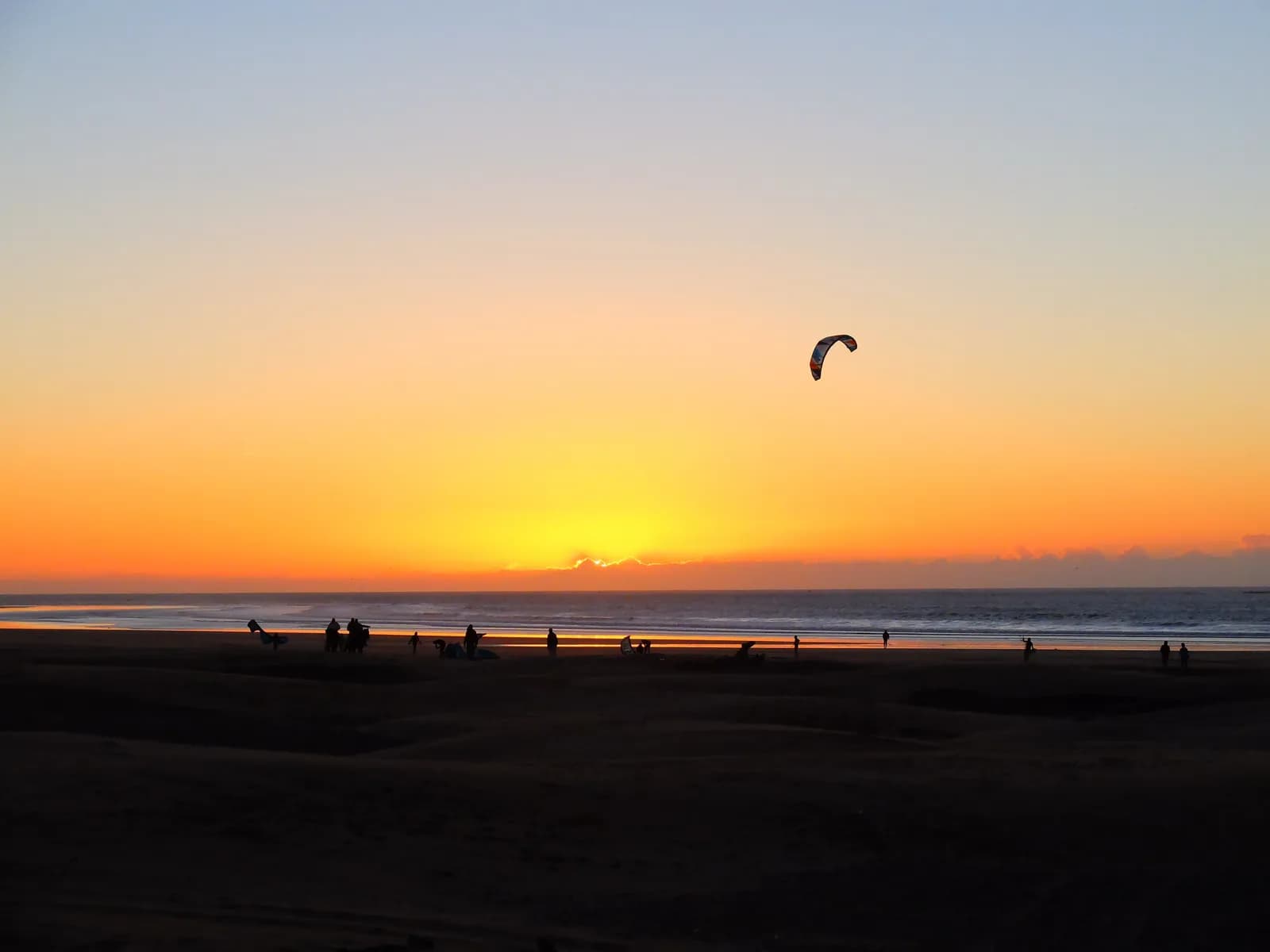
In Essaouira you read the weather in knots before you read it in degrees. A northerly wind, the trade wind, blows mostly from April to August, and mostly in the afternoon. It made the town’s name among kitesurfers, and it empties the beach at the hour other coasts fill up. The air stays mild all year, and the sea stays cool. This section carries the 7-day forecast, today’s wind spot by spot and twelve pages of climate normals, one per month. It does not yet carry tides or waves, and we say why below.
Why the wind is the whole story of this coast
The Azores High sends a north to north-easterly flow down the Moroccan coast: the trade winds. In summer it strengthens. The interior heats up, the ocean stays cold, and air is drawn from the sea onto the land every afternoon. In Essaouira, from April to September, it blows from the north to north-east in 83% of hours, and in 98% of the hours when it reaches 15 knots, by our calculation from the ERA5 reanalysis for 2016 to 2025.
The same wind does a second, less visible job. By pushing surface water offshore it lets cold water rise from below. Oceanographers call it upwelling. Morocco’s National Institute of Fisheries Research measured it from 1994 to 1998 between Cape Cantin and Cape Ghir, the stretch of coast Essaouira sits on. It is more active there in summer than in winter, and the water comes up at just 15 °C. Hence a sea that stays cool in August. We read two other traits of the town in it too. A haze that lingers on the beach in the morning, as warm air crosses cold water. A thermometer that never climbs the way it does in Marrakech.
Winter turns the scene round. From November to February the flow backs to the north-east and weakens, rain comes in short spells, and the bay has its calmest days. The month pages in this section give temperature, rain, sunshine, the daily peak wind and the number of days above 15 knots, month by month, from the station’s normals and our own count over thirty years of modelled weather data. Our when-to-visit guide turns them into an answer for your dates.
The rhythm of a windy day
A summer day does not blow all at once. The morning is the gentlest part, sometimes overcast. The thermal wind picks up in late morning and peaks from 14:00 to 17:00. From April to September, by our calculation from the ERA5 reanalysis for 2016 to 2025, it reaches 15 knots in 12% of hours at 06:00, 29% at noon and 40 to 43% from 14:00 to 17:00. It then eases into the evening, down to 25% of hours at 21:00. Hence the rule everyone ends up following here: the medina, the port and the beach in the morning, the water in the afternoon.
The hourly bars on the forecast page draw that curve for the next 48 hours. Dark blue marks the kite window: 15 to 30 knots, between 09:00 and 19:00. Four hours of window in a day and we rate it ideal for kiting. Above 30 knots the day is rated strong. Below 8 knots, calm.
One absence is deliberate. Our forecast comes from the Norwegian Meteorological Institute, MET Norway, which does not model gusts at this latitude. So we show no gust figure rather than invent one. The monthly normals carry none either. The weather model misses a good share of the strong-wind days, and we found no mean gust figure we could defend.
What 15, 20 and 25 knots mean
The knot is the unit on every wind page here, and it is 1.852 km/h. On the Beaufort scale as published by the UK Met Office, 15 knots is force 4, a moderate breeze, 11 to 16 knots. 20 knots is force 5, a fresh breeze, 17 to 21 knots. 25 knots is force 6, a strong breeze, 22 to 27 knots.
For a beach walker. At 15 knots the sand starts to run and a hat still stays on. At 20, sand stings your shins at low tide and a parasol becomes a projectile. At 25, you walk with your back to it and take the children in. Our advice: above 20 knots, the bay beach is walked in the morning or not at all, and watched in the afternoon from the Skala.
For a kiter. At 15 knots the bay becomes rideable on a big kite, and that is the floor of our kite window. At 20, it is the classic Essaouira afternoon, the one the schools exist for. At 25 and above, kites get smaller and Moulay Bouzerktoune becomes the spot for confirmed riders. Which water suits which level is our kitesurfing section’s job.
For a surfer, the reverse. From 15 knots of onshore wind the bay’s wave lies down and Sidi Kaouki’s turns to chop. Surfing happens early in the morning or from October to April, when the trade wind eases, and our surf pages give the season spot by spot.
The sea, the haze, and what this section does not show yet
The water stays cool all year. Our beaches section gives its temperature season by season, and our surf pages say which wetsuit it calls for. Our own normals hold no sea reading, and we would rather say so than copy a number.
The haze is the other surprise. In June, July and August, by our calculation from the ERA5 reanalysis for 2016 to 2025, low cloud covers more than half the sky on one morning in seven at 06:00, one in twenty at 10:00, and almost never in the afternoon. It is not bad weather, it is cold sea under warm air. The sun comes back with the wind.
Two pages are missing, and that is a choice. Tides and waves have no table here. The only practical source covering Morocco forbids commercial use, and this site will be commercial. For the tide, which decides how wide the bay is, use an official tide table. For swell, our surf pages give the season and the spot. The day a licensed source is budgeted, the tables come back here.
Until then, the routine that works: the wind spot by spot when you wake, the month page before you book, and our when-to-visit guide if your dates are still open.
Essaouira bay
Wind in Essaouira
Today
Light wind10kn NE
- Temperature
- 20–25 °C
Tomorrow
Light wind10kn SE
- Temperature
- 18–25 °C
Reading from · Data: MET Norway (CC BY 4.0)
Sub-sections
Frequently asked questions
What is the wind in Essaouira called?
The trade wind, a north to north-easterly carried by the Azores High and strengthened in summer by the heat inland. From April to September it blows from the north to north-east in 83% of hours, by our calculation from the ERA5 reanalysis for 2016 to 2025. It is the same wind that cools the water and fills the bay with kites.
What time does the wind get up in Essaouira?
In late morning, peaking from 14:00 to 17:00. From April to September it reaches 15 knots in 12% of hours at 06:00 and 40 to 43% from 14:00 to 17:00, by our calculation from the ERA5 reanalysis for 2016 to 2025. The hourly bars on our forecast page show the curve for the next 48 hours.
What does 20 knots of wind feel like?
Force 5 on the Beaufort scale, a fresh breeze, 17 to 21 knots or roughly 31 to 39 km/h. On the beach the sand stings and a parasol will not stand. On the water it is the typical Essaouira afternoon, in the middle of our 15 to 30 knot kite window.
Why is Essaouira hazy in the morning?
Because the sea is cold and the air is warm. The northerly wind draws cold water up from below, and the air crossing it condenses into a low veil. In June, July and August, low cloud covers more than half the sky on one morning in seven at 06:00 and almost never in the afternoon, by our calculation from the ERA5 reanalysis for 2016 to 2025.
Where do I find the tide times for Essaouira?
Not on this site yet: the only practical source covering Morocco forbids commercial use. Use an official tide table. Bear in mind that the bay is wide and firm at low tide, narrow at high tide.