Landmark · Mellah
Mellah d’Essaouira
The Mellah, the former Jewish quarter in the north of the medina, dates from 1804 and Sultan Moulay Slimane, according to the town’s 2012 map-guide. In 2025 UNESCO voiced concern at its decay and asked Morocco for a rehabilitation strategy, reporting by 1 December 2026. No plan for its houses had been published by 16 October 2026.
updated on
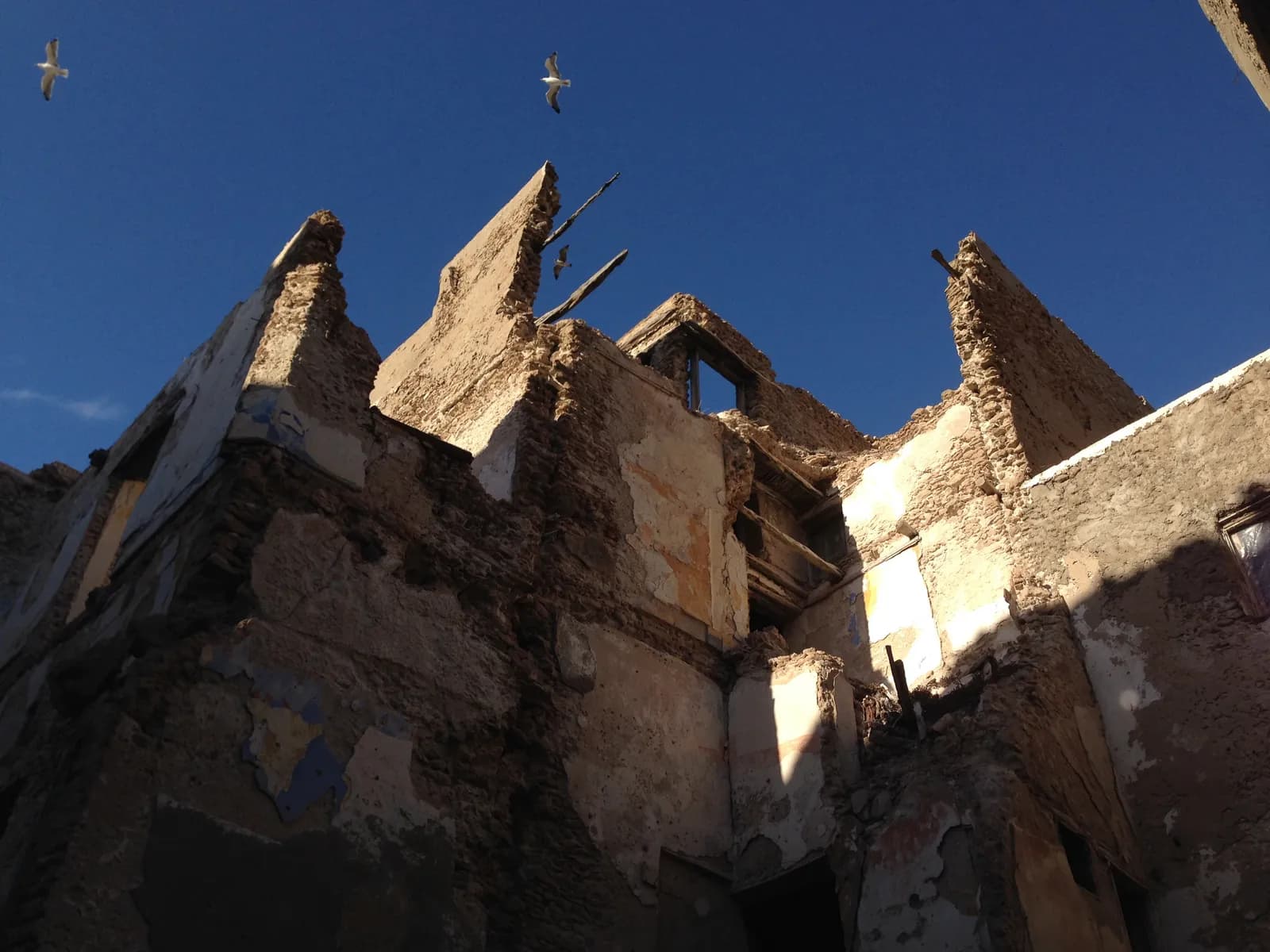
A quarter founded in 1804, largely demolished
The Mellah fills the north end of the medina, between rue du Mellah and Bab Doukkala. A map-guide published in 2012 by Essaouira town hall and the Junta de Andalucía dates it to 1804, under Sultan Moulay Slimane. Before then, Jewish families also lived in Derb Ahl Agadir, in the centre of the medina and in the kasbah.
The same guide records a second quarter, the Mellah Jdid, built in 1846 towards Bab Doukkala. It describes houses several storeys high, distilleries for mahia, the local fig spirit, mills and synagogues. By 2012 it called the quarter largely demolished. ICOMOS, assessing the medina before its 2001 World Heritage listing, sets out the community’s role: the sultan relied on it for trade with Europe, and its leading merchants held the title of the sultan’s traders.
Our view: look up. The tall houses are the clearest trace of this once-crowded quarter.
Three addresses, 9 minutes on foot
There is no ticket and no opening time for the quarter itself. From Bab Doukkala to Bayt Dakira, allow 660 m and 9 minutes without stopping, by our route calculation, plus the time for each visit. Slat Lkahal synagogue stands where a covered street begins, 220 m from the gate. The Slat Lkahal Mogador association, which restored it, lists phases of work from 2011 to 2016 on its website. In the same quarter, 60 m away, Rabbi Haïm Pinto’s house-synagogue is marked on the 2012 guide’s map.
Bayt Dakira is listed in the Mellah by directories. The former Slat Attia synagogue in fact stands on the kasbah side, near place Moulay Hassan. King Mohammed VI visited the House of Memory and the Haïm and Célia Zafrani research centre there on 15 January 2020. Outside the walls, beyond Bab Doukkala, the north-east gate, the old Jewish cemetery has deciphered headstones dated as early as 1775.
Our view: start at Bayt Dakira for the background, then walk up into the Mellah. None of the three publishes opening hours. Saturday is the Sabbath and none says whether it opens that day, so come on another day if you want to go inside the synagogues.
Restoration: new facilities, no plan yet for the houses
Among the last twelve projects of the 2019–2023 medina rehabilitation programme, listed by TelQuel in June 2024, the Mellah was to get a visitor centre and a relaid square. The list also held a care home, a youth centre, a women’s centre and a crèche for the quarter. A follow-up programme added two pre-school centres, Mellah 1 and 2, for 2 million dirhams (TelQuel, January 2024). As of 17 October 2026 we had found no dated official progress report on these works.
UNESCO sees the quarter differently. Its decision 47 COM 7B.177, in 2025, voices concern at the Mellah’s decay. It asks Morocco to settle who owns the Mellah’s buildings and to draw up a rehabilitation strategy, reporting back by 1 December 2026. Earlier reports had already flagged the lack of any policy for the quarter. Both things are true: social facilities have gone up, while nothing has been published for the houses or their ownership. The World Monuments Fund put the quarter on its 2018 World Monuments Watch, to document its history.
A plot cleared in 2012 or earlier was still empty in 2018, according to OpenStreetMap. Our view: stay in the streets and never step into a ruined house. For strolling, eating or staying in the area, our guide to the Mellah neighbourhood takes over. The ramparts and gates are gathered under Essaouira’s landmarks.
See on the map
The map loads tiles from OpenFreeMap. · Open in Google Maps
Frequently asked questions
What is the Mellah in Essaouira?
It is the former Jewish quarter at the north end of the medina. A map-guide published with the town hall in 2012 dates it to 1804, under Moulay Slimane.
Which synagogues can you visit in the Essaouira Mellah?
Slat Lkahal and the Haïm Pinto house-synagogue, both in the quarter. Bayt Dakira, the former Slat Attia synagogue, sits on the edge: directories list it in the Mellah, but it stands on the kasbah side.
Is the Essaouira Mellah being restored?
Not as a whole. The 2019–2023 medina programme planned social facilities there. In 2025 UNESCO was still asking for a strategy for the houses, with a report due by 1 December 2026.
How many Jews lived in Essaouira?
We found no figure published by an official source, so we give none. For the quarter itself, UNESCO counted about 6,200 residents on 4 hectares in 2004, and ICOMOS stresses the part Jewish merchants played in trade with Europe.
Is the Essaouira Mellah safe to walk?
The documented risk is the buildings: as early as 2008, UNESCO recorded buildings collapsing in the Mellah and houses on the point of collapse being pulled down. Keep to the streets and do not go into ruined houses.
How long do you need for the Mellah?
Allow 660 m and 9 minutes on foot from Bab Doukkala to Bayt Dakira, plus the time for each visit, which we have not timed. The quarter itself is free and has no opening hours.